
How to remember everything you read

You finished the book on Sunday. By Thursday, a friend asked what it argued and you gave them the title, the author, and one anecdote from the introduction. The middle two hundred pages, the part you had underlined, had gone.
This is not a memory problem, in the sense of a faculty that could be better. It is the ordinary result of reading the ordinary way. Reading is recognition: every sentence makes sense as you pass it, so it feels learned, and nothing about the experience tells you that the sense will not survive the week. The people who do keep what they read are not gifted. They do two things after the book is closed that the rest of us skip, and one of those two things is boring enough that most people who start it stop within a month.
This article is that method, in the order it has to happen, with the step that gets skipped named as such, and an honest account of which parts you should do yourself and which parts are worth handing to software.
Why it goes
Hermann Ebbinghaus measured this on himself in the 1880s, memorising lists of nonsense syllables and testing how many he could reproduce after an hour, a day, a week. The curve he drew fell steeply at first and then flattened: a large share was gone within a day, and what survived the first few days tended to survive much longer. A 2015 replication by Murre and Dros, with a modern subject and modern controls, found the same shape.
The syllables were nonsense on purpose, so the numbers do not transfer to a chapter on Roman tax policy. The shape does. Whatever you take from a book, most of the loss happens early, and what you can still recall a week later is what you are likely to keep.
Two things make reading worse than syllable lists. The first is that a book never asks you to reproduce anything. You are never tested, so you never find out what has gone until someone asks at dinner. The second is that the tools readers reach for, highlighting and rereading, were rated among the least useful study techniques in the largest review of the evidence, by Dunlosky and colleagues in 2013. They feel like work. They mostly are not.
Decide what "remember" would mean
"Everything" in the title is the promise people search for, and it is the wrong goal. A three-hundred-page book has perhaps a dozen things in it that you would want to reach for a year from now: an argument, a distinction, a number, a procedure, a name. The rest is scaffolding that carried those dozen things to you. Trying to keep the scaffolding is what makes the method collapse under its own weight in week three.
So the first decision is not how to remember but what. Three levels, and you want the second or third for anything worth the effort:
- Recognise it. You would know it if you saw it again. Reading gives you this for free and it is nearly useless, because you are never shown it again.
- Recall it. You could state it, unprompted, to a friend. This is what people mean when they say they remember a book.
- Use it. You could apply it to a situation the author never described. This is what you actually wanted from the book.
For an idea, aim at recall. For a procedure, aim at use. For a fact you might need to look up, aim at nothing and let it go; the index exists.
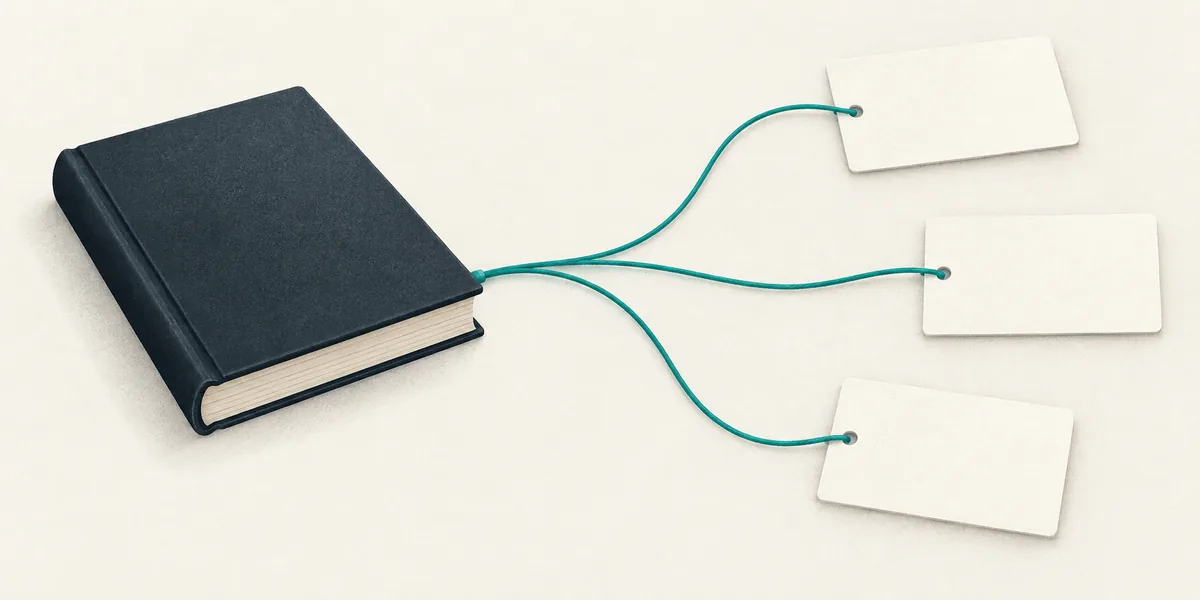
A useful card stays connected to the passage that supports it.
The method
Four steps. The first two happen while reading and cost almost nothing. The third is the one everyone skips. The fourth is the one everyone quits.
1. Read with a question
Before the first page, write down in one line what you want from this book. Not a summary of what it is about; what you are hoping to leave with. "How did the Meiji government centralise Japan so fast, and what did it cost them" is a question. "Learn about Meiji Japan" is not.
The question does two things. It tells you what to mark, so you do not underline every sentence that sounds important. And it makes the reading itself a search rather than a stroll, which is closer to the retrieval that actually forms memory. A reader looking for something notices when they find it.
If you cannot write the question, consider whether the book is worth reading now. Some are for later.
2. Mark, do not summarise
While reading, mark the passages that answer the question or surprise you. That is the whole rule. A mark is a bracket in the margin, a highlight, a folded corner. It is not a summary in the margin, not a note, not a rewrite in your own words. Those come later and they come slower, and doing them mid-read breaks the read.
Be stingy. A useful ceiling is one mark every several pages; a book that comes back with a mark on every page has not been read with a question. If you find yourself marking constantly, go back to step one.
3. Turn each mark into a question
This is the step that separates readers who keep things from readers who do not, and it is the one that gets skipped, because it is the first step that is real work.
Go back through the marks. For each one, write a question whose answer is the thing you wanted to keep, and write the answer under it. Then check that the question cannot be answered by recognition alone.
Suppose the marked passage explains that in 1871 the Meiji government abolished the han, the feudal domains, and replaced roughly 260 of them with prefectures run by centrally appointed governors, so that tax and conscription flowed to Tokyo instead of to the old lords.
A bad card from that passage:
Q: What happened in 1871?
A: The han were abolished.
It can be answered by a reader who remembers the date and nothing else, and in a month the date is the first thing to go. A better card:
Q: What replaced the han domains in 1871, and what did the Meiji government gain by doing it?
A: Prefectures under governors appointed from Tokyo. Tax and conscription now went to the centre rather than to some 260 local lords.
The second card carries the mechanism, which is the part you would actually want at dinner. It also carries the passage it came from, which matters more than it looks: a card you cannot trace back to its source is a card you cannot check, and in six months you will not remember whether the 260 was the book's number or yours.
A dozen cards from a book is a good yield. Forty is a sign that step one was skipped.
4. Bring it back before it is gone
Now the boring part. Each card comes back for review on a schedule that starts short and grows: a day, then a few days, then a couple of weeks, then months. At each review you try to answer before you look, and you grade yourself honestly. A card you got easily comes back later; one you missed comes back sooner.
This is spaced repetition, and the reason it works is the reason rereading does not: the effort of pulling something out of memory is what strengthens it, and the effort is greatest just before you would have lost it. How the spacing works is its own article; for now the rule is that you review when the schedule says, you do not reread the book instead, and you answer before you look.
It takes a few minutes a day. That is not the problem. The problem is that it takes a few minutes every day, and by the second week the novelty has gone and the cards from the book you were excited about are mixed in with cards from a book you have moved on from. Most people quit here. The next section is about why, and the one after is about what to do about it.
Where it breaks
The backlog. Miss four days and the queue that was seven minutes is forty. Most tools show you the whole pile, and a pile is something people avoid. The single most common reason people stop is not that the method failed but that they came back to a number that made them close the app. Whatever you use, it needs a ceiling on the day, not a total.
Too many cards. Forty cards from every book means four hundred cards by the fifth book, and the reviews are now dominated by things you did not need. Step one, taken seriously, fixes this. So does dropping a card the moment you notice you do not care about the answer.
Cards about trivia. The date, the name, the number, because they are easy to turn into questions. The argument, the distinction, the reason, because they are hard. The easy cards crowd out the hard ones and you end up remembering the scaffolding you decided not to keep.
Reviewing without recalling. Flipping the card to see the answer, nodding, and marking it as known. This feels like reviewing. It is rereading with extra steps and it trains nothing. The attempt has to happen before the reveal, even when it fails, especially when it fails.
Week three. Nothing feels different yet. The cards are due, the book is a memory, and there is no visible evidence the method is working, because the evidence is a thing you will not forget in March and it is still September. This is the stretch to get through, and the only advice that holds is to make the daily session small enough that skipping it is not a relief.
What to do yourself and what to hand over
Steps one and two are yours. Nobody else can decide what you want from a book, and marking while reading is close to free. Step four, the reviewing, is also yours; software can schedule it, but the recall has to happen in your head or nothing happens at all.
Step three is the one to think about. Writing good questions from marked passages is real work, it is the same work for every book, and it is the step where the whole method dies for most people, because on a Tuesday evening after a long day it is easier to start the next book than to write cards from the last one.
There are three ways to handle it, as of September 2026:
- Write them yourself, in Anki. Free on desktop and Android, a one-time purchase on iPhone, the largest community of any tool in this space, and full control over every card. The cost is that you are the one writing them, every time, and the tool shows you the whole backlog.
- Highlight, then review the highlights, in Readwise. If you already read on a Kindle or in a read-later app, Readwise collects the highlights and its Mastery mode turns the ones you choose into recall prompts. You still choose, one at a time, and the prompt is the highlight itself rather than a question written for recall. Compared here.
- Have the questions written for you, from the source, in Agent Memo. You capture the article, PDF, video or book; the agent reads the whole thing and proposes the dozen cards worth keeping, each traceable to the passage it came from; you see all of them before anything enters review and dropping one is a click. The day has a ceiling you set. This is the tool we make, so weigh the description accordingly, and note that it does step three, not step one: it does not know what you wanted from the book unless you tell it.
Whichever you pick, the test is the same. Two weeks in, is the daily session still happening. If it is, the tool is working. If it is not, the tool is the problem before the method is.
A first two weeks
A schedule for the first book, assuming you read it over the first week and review from day two.
| Day | What to do | Time |
|---|---|---|
| 1 | Write the question. Read. Mark sparingly. | Reading time |
| 2 | Turn the first day's marks into cards. Review nothing yet. | 15 min |
| 3–7 | Keep reading. Each evening, cards from that day's marks. Review what is due. | 10–15 min |
| 8 | Book finished. Last cards written. Review. | 15 min |
| 9–14 | Review only. Drop any card you no longer care about. | 5–7 min |
| 15 | Ask yourself the question from day one, out loud, without looking. | 5 min |
Day fifteen is the only test that matters. If you can answer the question you wrote before you started, the book stayed. If you cannot, look at which cards you missed most and whether they were about the answer or about trivia.
Frequently asked questions
Does highlighting help at all? As a way to mark what to come back to, yes; that is step two. As a way to remember, no. Dunlosky's 2013 review rated it low-utility, and the reason is that a highlight asks nothing of you. It is where memory work starts, not where it happens.
How many cards should a book produce? A dozen is a good yield for a serious non-fiction book; fewer for a novel, more for a textbook you need for an exam. If you are producing forty or more from a general book, the question from step one was too broad or was skipped.
Should I reread the book instead? Rereading is pleasant, feels productive, and was rated alongside highlighting in the same review. If you loved the book, reread it for that. Do not count it as retention work.
Does this work for fiction? Partly. What you keep from a novel is rarely a fact; it is a scene, a line, a way a character reasoned. Those can be cards ("What did she decide when the letter came, and why did the narrator think it was wrong") but most readers do not want them to be. A short note of the three things that struck you, reviewed once a month later, is often enough.
How long before it feels like it is working? Longer than you want. The proof is a thing you still know in three months, and there is no way to feel that in advance. The first honest signal is smaller: on day fifteen, you can answer your own question. Before that, the only thing to judge is whether the session is still happening.
What to do now
Pick the book you are reading, write the one-line question before the next chapter, and mark stingily through it. Tomorrow evening, write cards from the marks or let the agent propose them from the pages and keep the ones you want. Then review for seven minutes a day, and on day fifteen ask yourself the question. Read about why the attempt matters more than the answer when you get there.